
Carbon accounting software measures a company’s greenhouse gas emissions and converts activity data, such as kilowatt-hours of electricity or litres of fuel, into tonnes of carbon dioxide equivalent (tCO2e).
Businesses are accountable for a significant portion of global emissions, making that measurement work relevant to organisations of all sizes. These platforms allow companies to track, analyse, and reduce their carbon footprint using insights pinpointing high-emission areas, then set reduction targets and monitor progress over time.
Choosing the right software means finding one that records emissions across multiple scopes, provides in-depth insights, generates compliance reports, and aligns with regulatory standards. Which standards matters more than that phrase suggests.
A UK business is usually reporting under SECR, may qualify for ESOS, and from 2027 may fall under the UK Sustainability Reporting Standards. Anyone bidding for public sector work needs a Carbon Reduction Plan under PPN 006. A platform designed around EU CSRD reporting will not necessarily produce any of those.
In this guide, we outline the key features to consider when selecting carbon accounting software, such as security, integration, automation, or reporting, before highlighting the 9 best carbon accounting software options available. We also cover which UK rules apply at which thresholds, what these platforms typically cost, and when a consultant or a spreadsheet is the better answer.
The Options At a Glance - Comparison Table
| Platform | Best for | Pricing (as published on page) | HQ |
|---|---|---|---|
| Gaia | UK companies needing SECR and DEFRA/DESNZ alignment | From £300 + VAT per month | London, UK |
| Persefoni | Enterprises and financial institutions under disclosure scrutiny | Free Pro plan; enterprise $55,000–$250,000/yr | Tempe, Arizona, USA |
| Sweep | Supply chain transparency and supplier collaboration | €34,000–€195,000/yr (estimated) | Montpellier, France |
| Watershed | Granular data and global compliance at enterprise scale | $37,000–$264,000/yr (estimated) | San Francisco, USA |
| Emitwise | Manufacturing and industrial supply chains | £35,000–£100,000/yr (estimated) | London, UK |
| Net Zero Cloud | Organisations already running on Salesforce | From $48,000/yr, up to $210,000 | San Francisco, USA |
| CarbonChain | Heavy industry, commodities and asset-level data | On request | London, UK |
| Sphera | Regulated industries needing ESG, EHS and LCA together | On request | Chicago, Illinois, USA |
| Greenly | SMEs starting out, with European framework focus | From €3,800/yr | Paris, France |
| Normative | Audit-ready data where Scope 3 dominates | On request | Stockholm, Sweden |
| Plan A | Reduction planning rather than statutory filing | On request | Berlin, Germany |
The comparisons provided are based on publicly available information and are intended for general informational purposes only. We strive to ensure the accuracy and relevance of the data presented, but we cannot guarantee its completeness or timeliness. The comparisons reflect our interpretation of features, services, or pricing as of the date of publication and may not account for recent updates or changes.
What Is Carbon Accounting Software?
Carbon accounting software is a digital platform for businesses to measure their carbon emissions, then analyse and uncover areas of reduction. It allows businesses to effectively track and report their reduction progress to comply with regulations and meet sustainability targets.
The mechanism is the same across every platform in this guide. Activity data goes in: kilowatt-hours from utility bills, litres from fuel cards, passenger miles from travel bookings, spend from the purchase ledger.
The software multiplies each figure by a published emission factor and returns a result in tCO2e. In the UK, those factors come from the UK Government greenhouse gas conversion factors, published each June by the Department for Energy Security and Net Zero and still widely called the DEFRA factors.
The output is organised by scope, following the GHG Protocol Corporate Standard:
- Scope 1 for direct combustion
- Scope 2 for purchased energy
- Scope 3 for everything else in the value chain
This can involve scope tracking, energy efficiency, supply chain analysis, carbon offset management, renewable energy integration, and real-time data monitoring.
Carbon accounting is crucial for achieving and maintaining sustainable business practices. It helps companies comply with regulations and further aid the environment, rather than contributing to climate change.
How to Choose Carbon Accounting Software
When choosing carbon accounting software, it should comply with all relevant regulatory compliance, such as the GHG Protocol. Data accuracy is crucial, and the software must provide the tools to accurately capture, measure and record this information.
A provider is responsible for offering adequate support and training resources to ensure employees can effectively use the software. Choose a provider that offers close communication with the client and full-time support when assistance is required. Building on this, the platform itself should be user-friendly, with a comprehensive but accessible interface.
Software should offer seamless integration with any existing systems, such as CRMs or ERPs, as well as be scalable to meet any organisation’s size. Solutions should be cost-effective plus priority data security with robust encryption, secure data storage, multi-factor authentication, and compliance such as GDPR.
Our Experience – Why Trust Our Opinion?
As environmental legislation evolves, Gaia routinely provides solutions to keep UK businesses ahead of the curve.
Our carbon accounting platform is built around UK reporting rather than adapted to it. It applies the annual DEFRA and DESNZ conversion factors, follows GHG Protocol methodology, and generates SECR reports including the intensity ratio the regulations require. That is the lens we assessed every other platform through, and it is why the criteria above weight UK regulatory output more heavily than raw feature count.
We develop software solutions for businesses of all sizes. Recognising the importance of the Biodiversity Net Gain (BNG) policy early on, we launched the UK’s largest Natural Capital Asset Marketplace, offering a wide selection of BNG units from over 150 sellers in England. Our Marketplace helps developers meet environmental planning requirements by facilitating the sale of off-site BNG units, creating matches for sustainable development.
With our software Gaia Enterprise, we enable organisations from leading environmental charities to the most forward-thinking councils to maximise their green initiatives. They license a white-labelled version of the Marketplace for themselves, enabling the management, showcasing, and selling of their natural capital assets.
On the carbon side, Gaia does not sell credits. The platform records the offsets an organisation buys in a register (registry, vintage, serial range and retirement certificate) and reports them gross-first: offsets never reduce a scope total, they sit alongside it, which is exactly what a client or auditor wants to see.
One disclosure. Gaia appears first in the list below and we sell in this category, so read our entry with that in mind. Every claim in it is one you can test on a demo, and we have said what the product does not do as clearly as what it does.
The Best Carbon Accounting Software
1. Gaia
Best for: UK companies whose primary output is an SECR disclosure and who want purchased offsets recorded in a register and reported gross-first, never netted.
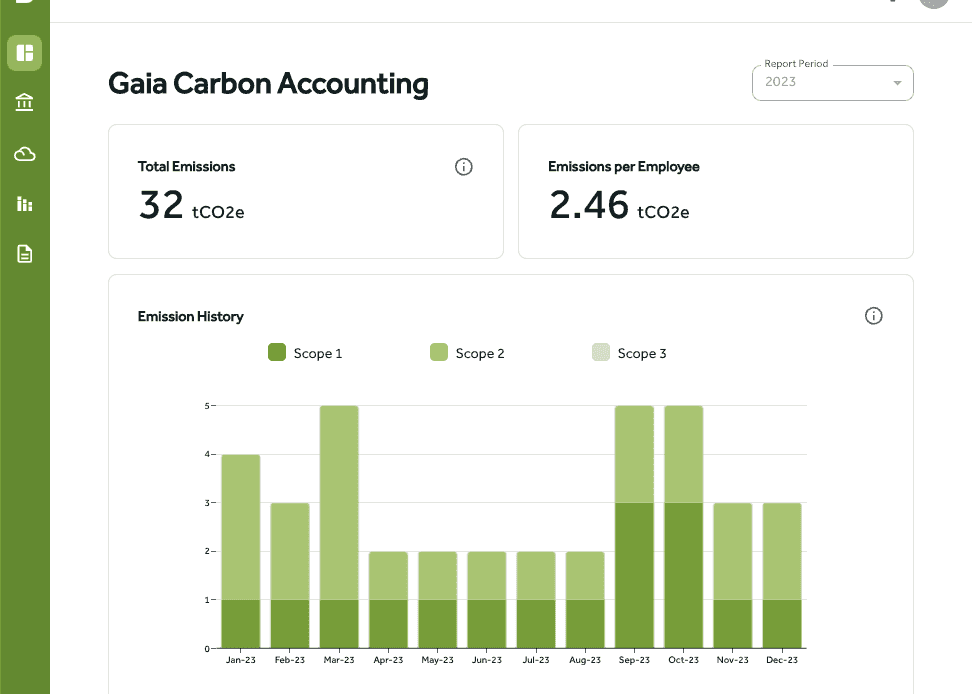
Gaia Carbon Accounting Software is a UK-built platform designed for organisations that want accurate, compliant, and transparent carbon management. Tailored to align with British regulatory frameworks such as SECR and DEFRA, it helps companies measure, report, and reduce emissions across every scope with precision.
Gaia covers Scope 1–3 emissions and includes advanced supply-chain analytics, enabling companies to capture complex Scope 3 data with ease. It also integrates directly with accounting tools, allowing teams to unify their sustainability and financial data.
Key Features
- Tracks Scope 1–3 emissions using the latest DEFRA and DESNZ conversion factors
- AI-powered analytics for real-time insights and forecasting
- Instant SECR reporting and B Corp impact assessments
- Integrations with Xero, QuickBooks, and Sage
Pros
✅ Designed for UK regulatory compliance
✅ High-accuracy reporting and streamlined workflows
✅ Combines measurement, reduction, and an offsets register (gross-first, never netted) in one ecosystem
✅ Scalable for SMEs and larger organisations
Cons
❌ Limited global compliance tools (currently UK-focused)
Pricing
Plans start at £300 + VAT per month, with tailored packages based on company size and sector.
Verdict
A comprehensive UK-focused carbon accounting solution, Gaia offers the depth, accuracy, and compliance alignment needed for modern sustainability strategies.
Website: /carbon-accounting-software/
Location: London, UK
2. Persefoni
Best for: financial institutions and large corporates facing investor, auditor or regulatory scrutiny.
Persefoni delivers enterprise-grade carbon accounting and disclosure capabilities for global organisations. Its platform automates GHG calculations and supports frameworks such as TCFD, CDP, and SEC, making it well-suited to companies that manage large, complex datasets.
Key Features
- Automated tracking across Scopes 1–3
- AI-driven analytics and audit-ready reporting
- Built-in support for TCFD, CDP, and SEC disclosure standards
- Expert guidance through the Sustainability Advisory Board
Pros
✅ Robust governance and compliance tools
✅ Sophisticated analytics for large operations
✅ Free starter plan available
Cons
❌ Setup can be complex for smaller organisations
❌ High enterprise pricing
❌ US regulatory heritage, so UK SECR output is supported rather than native
Pricing
Free “Pro” plan available; enterprise pricing ranges from $55,000 – $250,000 per year.
Verdict
A comprehensive and reliable enterprise platform for detailed carbon disclosure and sustainability reporting.
Website: persefoni.com
Location: Tempe, Arizona, USA
3. Sweep
Best for: organisations whose footprint is dominated by suppliers and who need those suppliers to participate.
Sweep enables businesses to measure, manage, and report their carbon emissions while encouraging collaboration across supply chains. It’s particularly strong in managing Scope 3 data and supplier engagement, helping organisations meet shared sustainability targets.
Key Features
- Scope 3 data collection and supplier collaboration tools
- Custom dashboards and performance tracking
- Built-in support for CDP and SBTi reporting
- Real-time progress tracking and benchmarking
Pros
✅ Excellent for supply-chain transparency
✅ Intuitive, modern interface
✅ Comprehensive compliance functionality
Cons
❌ No free plan
❌ Higher price range
❌ Breadth can mean a heavier setup than a SECR-only requirement needs
Pricing
Estimated between €34,000 and €195,000 per year, depending on company size.
Verdict
A high-performing solution for organisations seeking collaborative carbon management across complex value chains.
Website: sweep.net
Location: Montpellier, France
4. Watershed
Best for: large enterprises with in-house sustainability teams and mature data infrastructure.
Watershed provides a complete platform for carbon measurement, management, and disclosure, focusing on real-time data processing and accuracy. With over 60,000 emission factors and 60+ system integrations, it helps companies gain detailed insight into their environmental impact.
Key Features
- Real-time emissions tracking and dashboards
- Integrations with 60+ software systems
- Compliance with SEC, SBTi, and GHG Protocol
- Extensive emissions factor database
Pros
✅ Data-rich and reliable
✅ Trusted by global enterprises
✅ Comprehensive compliance coverage
Cons
❌ No free demo available
❌ Enterprise-level pricing may deter smaller firms
Pricing
Estimated between $37,000 and $264,000 annually.
Verdict
An advanced, data-driven platform suited to organisations requiring granular insights and global compliance.
Website: watershed.com
Location: San Francisco, USA (offices in New York, London, Sydney)
5. Emitwise
Best for: manufacturers and industrial businesses where Scope 3 is most of the footprint.
Emitwise offers automation-driven carbon management for large organisations with complex operations. It combines financial-grade accuracy with streamlined supplier engagement, helping companies identify and reduce emissions across their entire value chain.
Key Features
- Automated Scope 1–3 emissions tracking
- API-based integration with enterprise systems
- High-accuracy, audit-ready data
- Tools for supply-chain decarbonisation
Pros
✅ Excellent for manufacturing and industrial sectors
✅ Strong supplier engagement functionality
✅ Reliable emissions precision
Cons
❌ Focused on large, complex enterprises
❌ Limited flexibility for smaller organisations
Pricing
Estimated between £35,000 and £100,000 per year.
Verdict
Emitwise provides precise, automation-driven accounting ideal for data-intensive industries focused on supply-chain sustainability.
Website: emitwise.com
Location: London, UK
6. Net Zero Cloud (Salesforce)
Best for: companies already running their business on Salesforce.
Salesforce’s Net Zero Cloud unites ESG and carbon management with its familiar CRM and analytics environment. It allows users to track emissions alongside broader sustainability metrics, benefiting those already using Salesforce products.
Key Features
- Integration with Salesforce CRM and analytics
- Real-time data dashboards
- Access to the Net Zero Marketplace for offsetting
- Broad ESG management beyond carbon
Pros
✅ Seamless for existing Salesforce users
✅ Powerful analytics and scalability
✅ Unified sustainability reporting
Cons
❌ High cost for smaller teams
❌ Complex setup for non-Salesforce users
❌ UK statutory report formatting needs configuration
Pricing
Starts at $48,000 per year for the Starter edition; up to $210,000 for advanced plans.
Verdict
A sophisticated, enterprise-level tool that extends Salesforce’s capabilities into sustainability and carbon management.
Website: salesforce.com
Location: San Francisco, USA
7. CarbonChain
Best for: commodities, metals, mining, shipping and other high-emission supply chains.
CarbonChain focuses on carbon accounting for heavy industries, commodities, and manufacturing. It delivers asset-specific data and end-to-end supply-chain coverage, offering a specialised solution for high-emission sectors.
Key Features
- Automated Scope 1–3 tracking across industrial supply chains
- Data coverage for over 100,000 assets globally
- AI-driven emissions modelling
- Detailed reporting for commodity-based sectors
Pros
✅ Exceptional detail for industrial operations
✅ Reliable automation for large data volumes
✅ Trusted by financial and commodity institutions
Cons
❌ Niche focus limits broader business appeal
Pricing
Pricing available on request.
Verdict
A specialised platform for industrial supply chains seeking high-accuracy carbon accounting and reporting.
Website: carbonchain.com
Location: London, UK
8. Sphera
Best for: manufacturing, energy and chemicals businesses that need product-level carbon as well as corporate.
Sphera offers a robust ESG and carbon accounting suite aimed at regulated industries such as energy, chemicals, and manufacturing. Combining carbon tracking with health, safety, and environmental management, it provides a unified sustainability framework.
Key Features
- Comprehensive ESG and EHS integration
- Strong compliance for high-regulation industries
- Flexible reporting and analytics tools
- Advanced data management and audit trail
Pros
✅ Excellent for large, regulated sectors
✅ Broad compliance support
✅ Deep integration across sustainability and safety
Cons
❌ Steeper learning curve
❌ Complex setup process
❌ Enterprise scale; not a fit for an SME with a single SECR filing
Pricing
Pricing available on request.
Verdict
A comprehensive, enterprise-level platform for carbon and ESG management across complex, high-regulation environments.
Website: Sphera
Location: Chicago, Illinois, USA
9. Greenly
Best for: smaller businesses making a first inventory, particularly with European operations.
Greenly is an accessible carbon accounting platform designed for small to medium-sized businesses. It automates data collection, integrates with common business tools, and provides audit-ready emissions reports aligned with European compliance standards.
Key Features
- Tracks Scope 1–3 emissions with automation
- Integrations with Google Cloud, Shopify, AWS, and others
- User-friendly dashboards and progress tracking
- Audit-ready reporting and reduction guidance
Pros
✅ Easy to use for smaller teams
✅ Affordable, transparent pricing
✅ Excellent integrations for digital businesses
Cons
❌ Primarily focused on European frameworks
❌ Limited customisation for large enterprises
❌ Spend-based defaults can be blunt for Scope 3 hotspot analysis
Pricing
Plans start from €3,800 per year for GHG Report Compliance, rising to €7,800 for Net Zero Contributor.
Verdict
A cost-effective and intuitive option for smaller businesses beginning their carbon accounting journey.
Website: Greenly
Location: Paris, France
10. Normative
Best for: enterprises that need emissions data to withstand external assurance, with Scope 3 as the main exposure.
Normative is one of the longest-established platforms in this category, with a London office alongside its Stockholm base. Its emphasis is data quality and Scope 3 depth, supported by a dedicated climate expert assigned to each account rather than self-service onboarding.
It connects directly to procurement systems to build value chain figures from real purchasing data rather than estimates, which is slower to implement and considerably more defensible. If you are already comparing it against alternatives, we have a fuller breakdown in our guide to Normative alternatives.
Key Features
• Scope 1–3 calculation engine aligned to the GHG Protocol
• Activity-based Scope 3 with procurement system connections
• Science-based target support and emissions hotspot analysis
• Dedicated climate expert model rather than self-service
Pros
✅ Deep Scope 3 value chain accuracy
✅ Expert-led implementation
✅ Strong audit trail for assurance
Cons
❌ Enterprise-oriented and heavy for a small team
❌ Pricing not published
Pricing
Not published. Quoted on enquiry.
Verdict
A strong choice where emissions data has to withstand scrutiny and Scope 3 dominates the footprint
Website: normative.io
Location: Stockholm, Sweden, with offices in London and Copenhagen
11. Plan A
Best for: companies whose goal is a credible reduction pathway rather than a statutory filing.
Berlin-based Plan A treats measurement as the input to a reduction roadmap rather than the end product. Scenario modelling lets a company map several routes to a target and compare them on cost and feasibility before committing.
Plan A states that its calculation methodology is independently certified and that it maintains a scientific advisory board. If reduction planning rather than compliance filing is your driver, that orientation is the reason to shortlist it.
Key Features
• Scope 1–3 accounting with AI-assisted data mapping and anomaly detection
• Scenario modelling for comparing reduction pathways
• CSRD and ESRS reporting support
• Advisory services alongside the platform
Pros
✅ Reduction planning built in rather than bolted on
✅ Strong advisory and expert support
✅ Well-developed scenario and pathway modelling
Cons
❌ Built around EU frameworks; SECR is not the primary output
❌ Pricing not published
Pricing
Not published. Quoted on enquiry.
Verdict
The stronger option where the objective is a defensible decarbonisation plan rather than a compliance document.
Website: plana.earth
Location: Berlin, Germany
Criteria We Used to Choose the Software on This List

1. Dynamic Scope 1, 2, and 3 Emissions Calculation
The GHG (Greenhouse Gas) Protocol is the most widely used international framework for recording emissions. It measures direct emissions (Scope 1), indirect emissions (Scope 2), and emissions from the entire value chain (Scope 3).
The software must precisely measure and calculate emissions across all scopes, and automating data collection ensures accuracy while reducing the manual effort involved in gathering emissions data from various sources.
Scope 3 is where most inventories are incomplete, and where the differences between platforms show up. The Corporate Value Chain (Scope 3) Standard defines fifteen categories and requires that any excluded category is disclosed and justified rather than quietly dropped. Ask a vendor to show you which categories it covers and how it handles the ones it does not. Our guide to measuring and reducing Scope 3 emissions sets out what each category involves.
Ask, too, which method it defaults to. Spend-based calculation multiplies procurement spend by an industry-average factor, which is fast, cheap and blunt: cut your supplier’s price and your reported emissions fall, even though nothing changed. Activity-based calculation uses real quantities from real suppliers, which is slower to set up and far more useful for finding reductions. Good platforms start spend-based and let you refine category by category to actuals.
For Scope 2, check whether the platform defaults to location-based accounting, which uses the average grid factor, or market-based accounting, which reflects your energy contracts. The two produce different figures, and a platform that reports only one leaves you unable to disclose both.
It should integrate well with energy management systems, utility management systems, or any other platforms providing Scope 1-3 emission data.
Additionally, advanced reporting and analytics features are essential for tracking progress and ensuring compliance with global standards.
2. Ease of Use
Managing business-wide emissions, regardless of scale, requires a comprehensive and intricate software. The best solutions will be sophisticated and user-friendly, offering powerful features while remaining accessible to all users.
These should consist of intuitive interfaces with sleek navigation and organised menus.
Data collection should be automated where appropriate to save on admin and optimise accuracy and efficiency of emissions tracking.
Built-in tips or tutorials can be available to guide starting users through the more complex areas (such as Scope 3 data quantification), or the provider should be able to efficiently respond to customer queries and swiftly offer support.
3. Integration
Ensure that your carbon accounting software solution can seamlessly integrate with a range of relevant systems, databases, and tools.
By connecting to a business’s energy management systems, it gains real-time energy usage data for efficient reporting.
With CRM (customer relationship management) integration, client lifestyle emission data is passed over, allowing for accurate Scope 1 data emissions.
Software could integrate with GIS (Geographical Information Systems) to identify areas to target, plus allow for the visualisation of geographical emissions data.
Ensure the software can seamlessly integrate with other systems through APIs, such as ERP (Enterprise Resource Planning) systems, HR databases, or third-party emissions calculators.
4. Scalability
Carbon accounting software should ensure they are scalable to account for business growth and subsequent growth in data volumes. This can be achieved by cloud-based architecture, for example, which allows for a rapid and flexible addition of servers or storage.
Regulatory compliance can evolve rapidly, such as changes in emission calculation methodologies. Software should be scalable to adapt to these changes, to ensure their customers remain compliant.
Furthermore, the software should be adaptable to incorporate advancing technologies, such as utilising AI for a comprehensive data analysis. Another example is IoT devices (such as vehicle trackers, environmental sensors, or wearable tech) for real-time data collection.
5. Reporting and Analytics
A strong carbon accounting platform should be able to offer data visualisation at a granular level for enhanced decision-making, compliance and reporting accuracy, as well as a precise breakdown of emissions across various departments.
It should be able to identify trends over time, with predictive insights to forecast future emissions and energy consumption, helping businesses set realistic targets.
Benchmarking practices allow businesses to implement methods from top-performing companies, directly influencing and improving their sustainability efficiency.
Your solution should be able to produce sleek, clear regulatory compliance reports in the click of a button, allowing you to share your reduction progress with any relevant stakeholders.
6. Compliance
Software should be able to generate thorough compliance reports with ease that comply with all relevant bodies, such as SECR (Streamlined Energy and Carbon Reporting), or UK ETS (Emissions Trading Scheme).
This allows companies to comply with enhancing carbon regulations, and lessen chances of penalties or fines from breaking regulations.
Businesses can then further strengthen relationships with regulators like the UK Environment Agency, while also supporting eligibility for government incentives like Enhanced Capital Allowances (ECAs).
7. Automation Capabilities
Software should be able to automate data collection. An example is integrating with smart metres to aggregate data over time and gaining a comprehensive analysis of emissions trends without the need for manual admin.
AI can be integrated to power insights, such as AI-based anomaly detection, or predictive analytics for future emissions to identify opportunities for reductions.
The software should automate tasks like generating regular emissions reports, sending notifications for key deadlines, and flagging potential compliance risks.
Data input should bring automatic GHG calculations, following a globally-recognised framework for consistent and accurate measurement.
8. Customisation Options
Your Carbon Accounting Software of choice should offer powerful customisation options, to ensure they encompass a broad scale of varied businesses.
Custom data fields and dashboards would allow for flexible data entry. The core system could offer add-on modules based on regions, industries, or regulations.
Businesses can then spotlight industry-specific metric tracking or target specific regulations.
Customisable workflow automations would allow businesses to optimise their carbon accounting processes based on any set needs. This could be approvals for data entry, custom alerts, automatic report generation, and more.
9. Security and Data Privacy
Software must ensure end-to-end data encryption to instil user confidence with data integrity, while avoiding risks of data breaches.
Multi-factor authentication should be required when accessing sensitive systems or data, reducing the risk of account takeovers by forcing users to verify their identity. This is an additional layer of security beyond a password.
Security audits should be routinely performed which can identify threats and vulnerabilities of data such as hackers, before it has risk of being exploited.
10. Customer Support
Carbon accounting solutions should offer a variety of reliable customer support options, such as a 24/7 online support portal.
This provides round-the-clock instant access to troubleshooting and FAQs, reducing wait times for common queries, and encourages user independence. Without this, users may be forced to face delays amongst critical moments.
A primary account manager could offer tailored assistance personalised across a wide range of businesses, helping customers optimise their experience for a range of set contexts.
The provider should also offer close communication with the client when needed.
11. Cost and Pricing Model
Just because you’re securing a powerful software doesn’t mean it has to be the most expensive option.
Solutions should have transparent pricing structures without hidden fees, simplifying comparisons with competitors, and strengthening trust with customers.
Flexible subscription plans should accommodate a vast scale of business, with affordable options for startups, all the way to premium offerings for enterprises.
The Importance of Carbon Accounting
With carbon being the leading driver of climate change, businesses have a critical responsibility to acknowledge and address their impact. They add layers of greenhouse gas to the atmosphere and trap heat, raising the planet’s surface temperature, causing extreme weather, rising sea levels, droughts, biodiversity loss and ocean acidification.
One person can make a positive environmental impact by reducing carbon emissions, but the scale at which businesses operate holds immense potential to significantly help preserve the planet’s atmosphere.
‘Large’ companies in the UK (with over 250 employees, £36 million in turnover, or £18 million in balance sheet total), must meet CA standards by law, under the SECR (Streamlined Energy and Carbon Reporting) framework.
Beyond this, CA crucially prevents green-washing and other misleading claims regarding environmental responsibility, with optimal reduction efforts then streamlined reporting tools for transparency. It enhances brand reputation, demonstrating environmental responsibility to customers, investors, and stakeholders. It helps businesses future-proof their operations against increasingly stringent environmental regulations, and keep up with consumers increasingly seeking eco-friendly brands.