
UK SRS reporting software
The UK Sustainability Reporting Standards will ask companies for climate disclosure in the ISSB's four-pillar shape, built on emissions data investors can trust. Gaia prepares that climate disclosure from the numbers you already measure, so when the first reporting year arrives the data behind it is already a year deep.
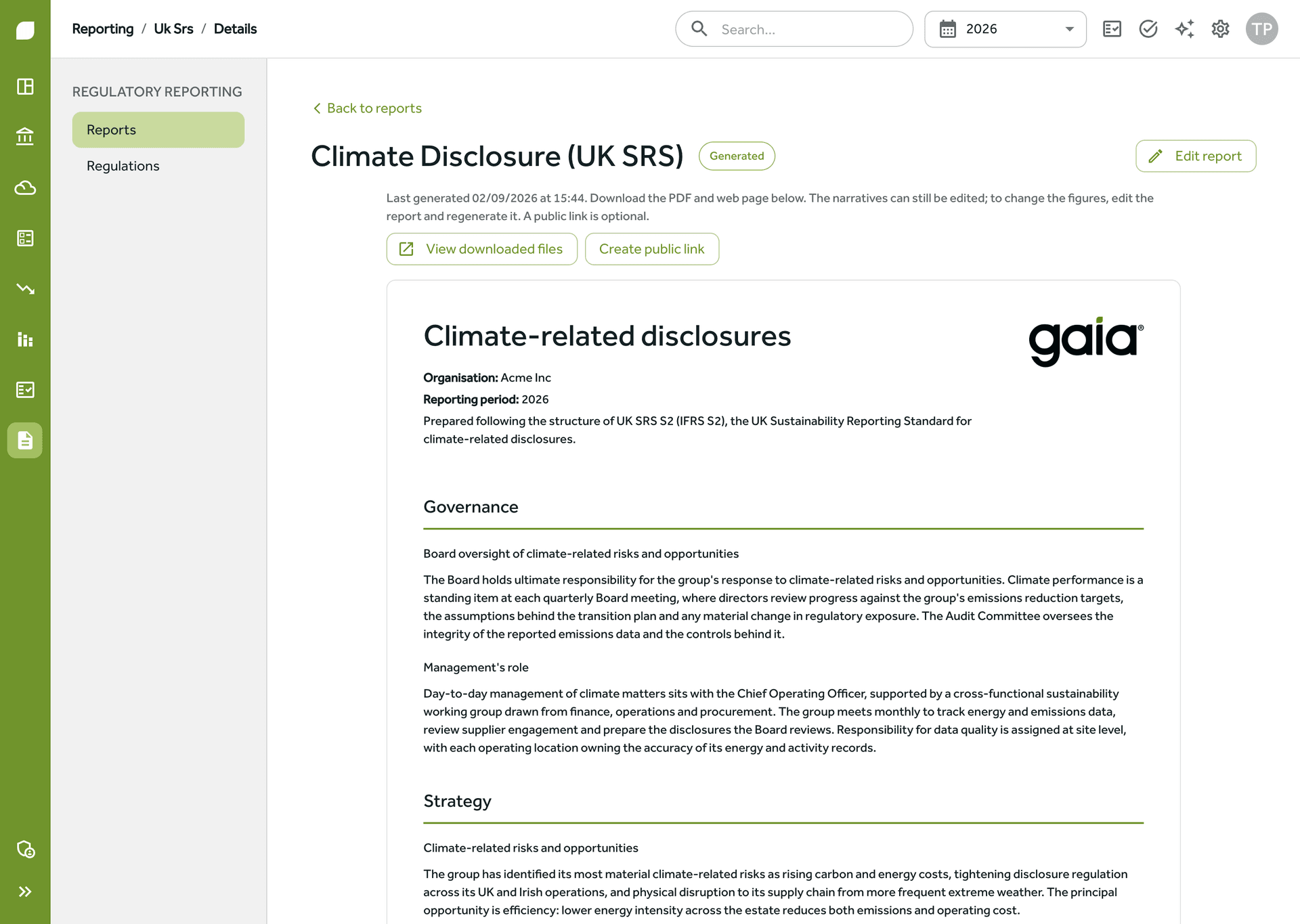
The climate disclosure UK SRS asks for
Generate an IFRS S2-shaped report from real emissions data, with every figure reconciling to your SECR and GHG reports
What is UK SRS?
The UK Sustainability Reporting Standards (UK SRS) are the UK's adoption of the International Sustainability Standards Board (ISSB) standards: IFRS S1 for general sustainability-related disclosures and IFRS S2 for climate-related disclosures. The UK government confirmed implementation on 25 February 2026, and the standards are expected to take effect from 2027. They are expected to apply first to UK-listed companies through Financial Conduct Authority rules, with wider application under consultation.
The climate standard is the demanding half. It asks for disclosure across four pillars: governance, strategy, risk management, and metrics and targets, with greenhouse gas emissions measured in line with the GHG Protocol Corporate Standard. This is disclosure written for investors, which means the numbers need the same discipline as the accounts they sit beside: a clear methodology, evidence behind every figure, and gaps declared rather than smoothed over.
The practical consequence is about timing. Climate disclosure is built to show movement, and a first report reads very differently with a year of history behind it than with a blank comparative column. If the standards take effect from 2027 as expected, the year readers will want to compare against is the one before it. Start measuring with Gaia's carbon accounting software now and your first UK SRS disclosure opens with investor-grade data already collected, structured and evidenced.
What a UK SRS climate disclosure contains
IFRS S2 structures climate disclosure around four pillars. Gaia generates the report in that shape, with the narrative sections yours to write and the metrics calculated from your measured emissions.
Governance
Strategy
Risk management
Metrics and targets
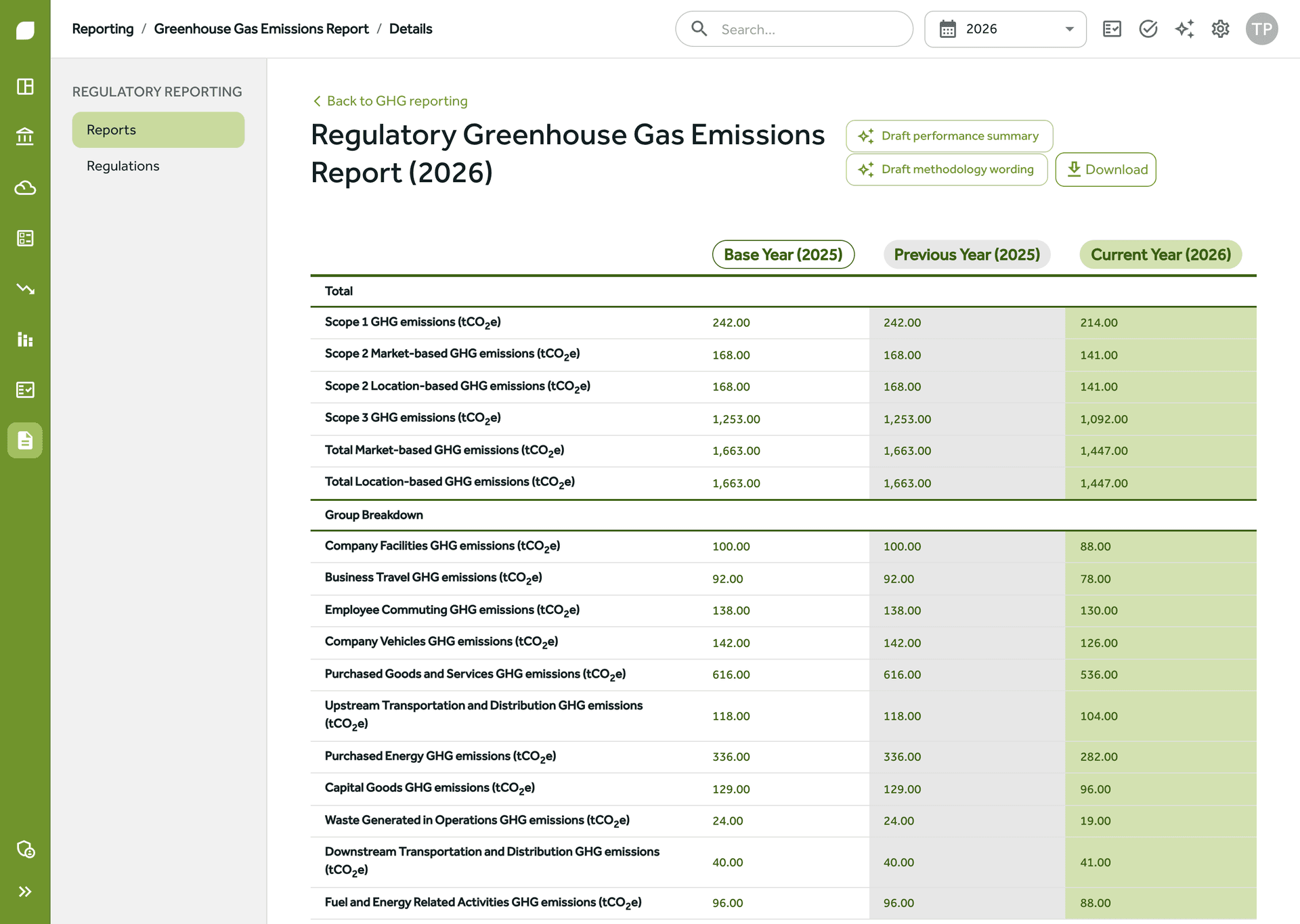
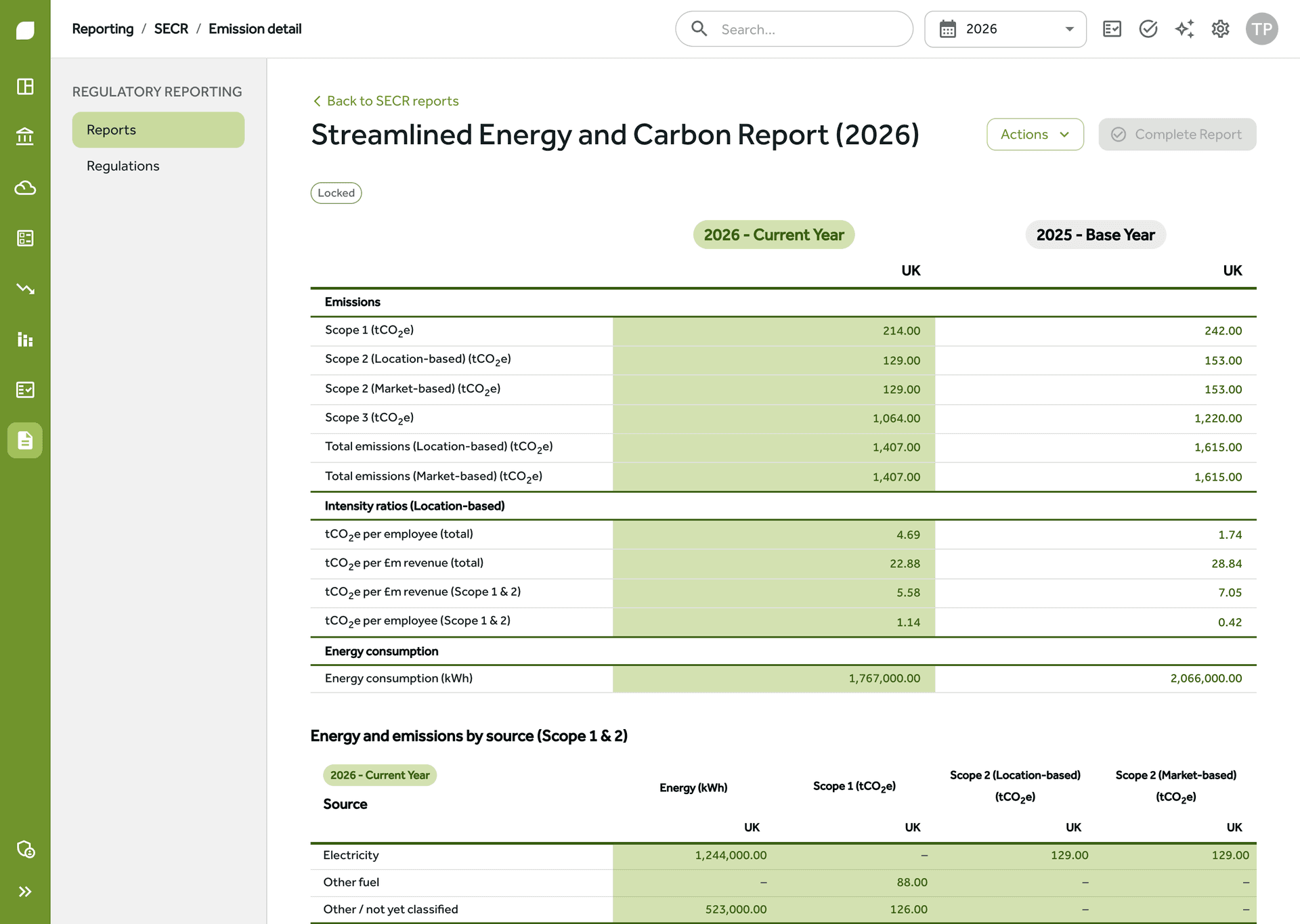
The same numbers as your SECR and GHG reports
Your UK SRS climate disclosure is built from the same emissions inventory as your SECR and GHG Protocol reports, calculated once by the same engine from the same evidence. Because every document draws on that one inventory, an investor reading the climate disclosure next to the SECR report is reading the same numbers, not three near misses that each need explaining.
A disclosure that stays what you published
When you generate the report, its figures are frozen at that moment. Later imports, corrections and factor updates never quietly rewrite a document you have already shown to the board or shared outside the business. The disclosure exports as a PDF and a publishable web page, and a revocable share link lets you circulate it before anything is public, then withdraw access just as cleanly.
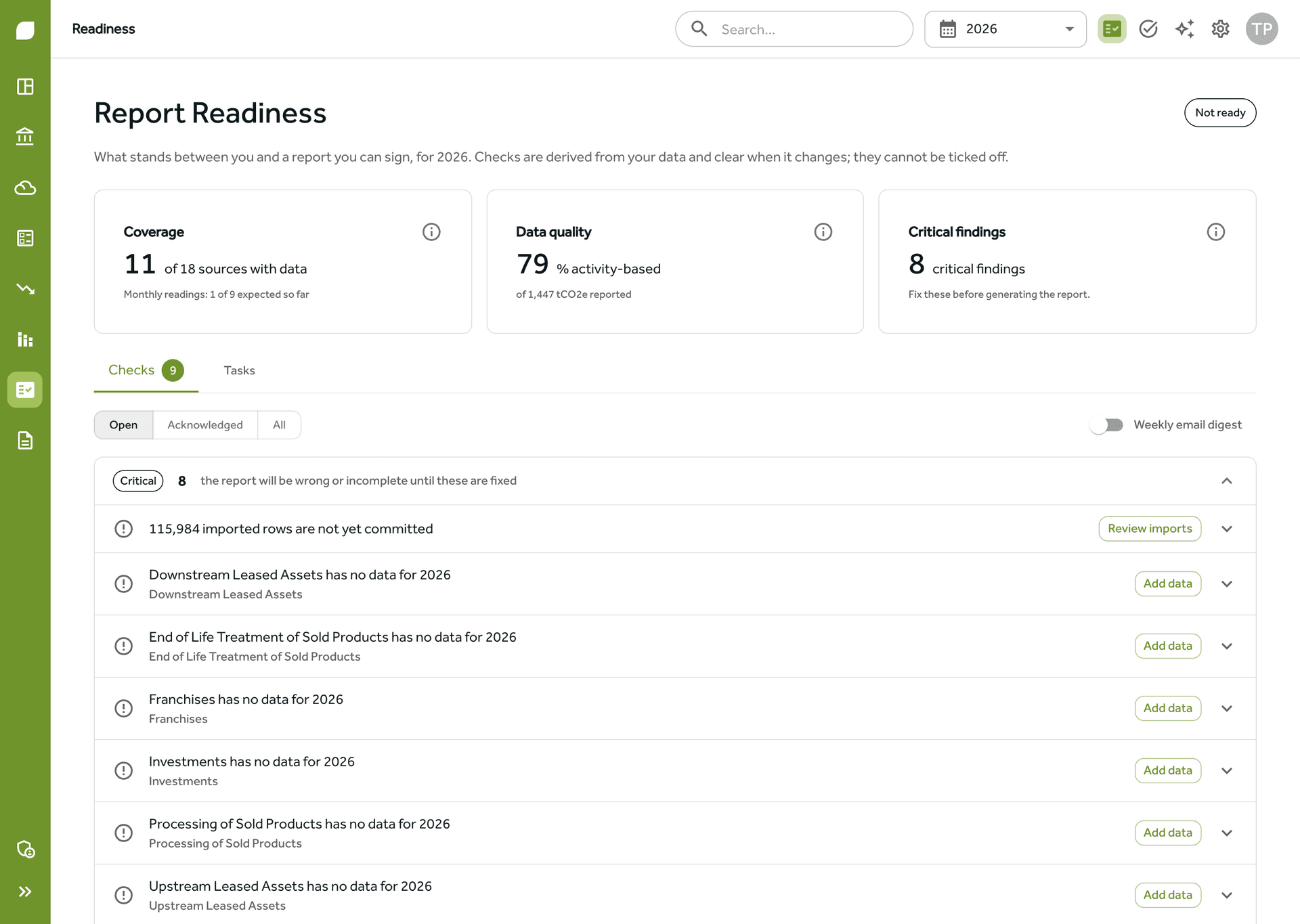
A gap is declared, never papered over
Investor-facing disclosure fails on the day someone finds a confident-looking number with nothing behind it. In Gaia, a narrative section you have not completed renders "Not disclosed." in the published document rather than pretending, and missing emissions data is never a silent zero: Scope 3 coverage is shown as a count of categories, and every figure carries its data-quality tier from the GHG Protocol method hierarchy. The report tells the truth about its own limits, which is exactly what this audience checks first.
SECR, GHG Protocol, PPN 006 and UK SRS from the same numbers
UK SRS does not arrive on a clean desk: most companies in its expected scope already produce a SECR report, many publish a PPN 006 Carbon Reduction Plan, and some report to the GHG Protocol besides. In Gaia these are different documents drawn from one dataset, so each new framework is a new output from the same inventory, not a new data collection exercise.
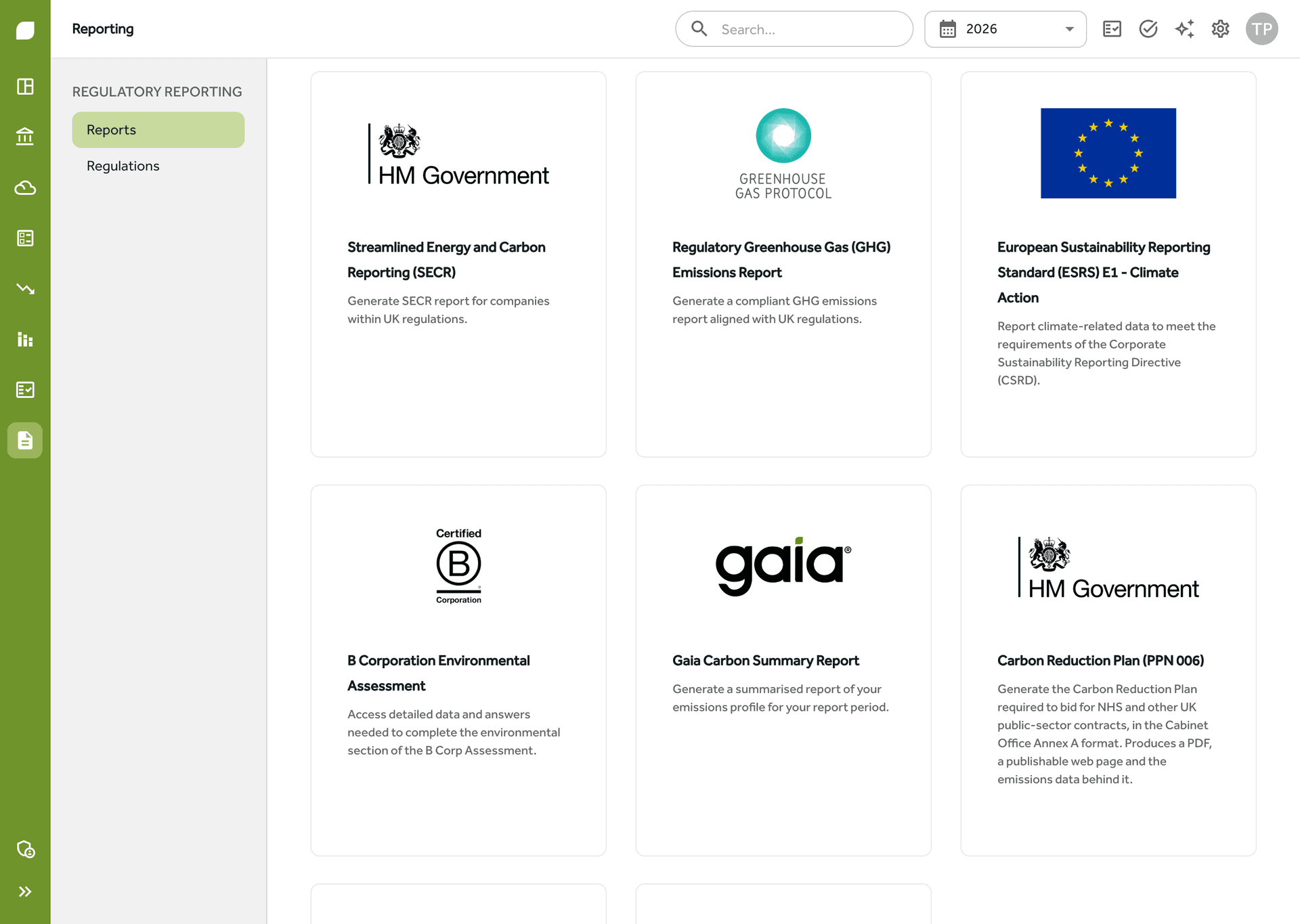
See a UK SRS climate disclosure built from real data
Built on the standards behind UK SRS
IFRS S2 asks for greenhouse gas emissions measured in line with the GHG Protocol Corporate Standard. That is exactly how Gaia calculates every number, using the annual conversion factors published by the Department for Environment, Food and Rural Affairs (DEFRA) and the Department for Energy Security and Net Zero (DESNZ).
Trusted climate data



Common questions about UK SRS
What is UK SRS?
The UK Sustainability Reporting Standards are the UK's adoption of the ISSB standards, IFRS S1 for general sustainability-related disclosures and IFRS S2 for climate-related disclosures. The UK government confirmed implementation on 25 February 2026, and the standards are expected to take effect from 2027. The climate standard structures disclosure around four pillars: governance, strategy, risk management, and metrics and targets.
Who will UK SRS apply to?
The standards are expected to apply first to UK-listed companies through Financial Conduct Authority rules, with wider application to large private companies under consultation. Nothing about scope is final until the rules are made, so treat any threshold you read as expected rather than settled. What is already clear is the direction: investor-grade climate disclosure is coming to more UK companies, and the companies that find it easy will be the ones already measuring.
How does UK SRS relate to SECR?
SECR continues: it is an existing legal requirement under company law, and a UK SRS disclosure does not remove it. The two ask for overlapping data in different documents, which is exactly the problem Gaia is built around: one emissions inventory produces the SECR report and the UK SRS climate disclosure, so the figures reconcile and neither report is a separate data collection exercise. If the frameworks converge in the future, the data behind both is already structured.
How does UK SRS compare with CSRD and the ISSB standards?
UK SRS is the UK's version of the ISSB standards, so a company reporting under UK SRS is reporting ISSB-shaped, investor-focused, single-materiality disclosure. The EU's Corporate Sustainability Reporting Directive (CSRD) is a separate and broader regime built on double materiality. They are cousins, not copies, but the climate data underneath them is largely the same. Gaia produces CSRD climate disclosures for UK companies with EU exposure from the same dataset as the UK SRS report.
When should we start preparing?
Before your first reporting year, not during it. Climate disclosure is built to show movement, and a first report with a populated comparative year reads very differently from one that starts at zero. If the standards take effect from 2027 as expected, the year investors will want to compare against is the one before it, and you cannot collect last year's data retrospectively to investor grade. Starting now costs a subscription; starting late costs a credible first disclosure.
Does Gaia file or approve the disclosure for us?
No, and nothing does that for you. Board oversight, the governance and strategy narratives, sign-off and publication stay with you, and generating a document does not by itself make you compliant with anything. What Gaia does is prepare the climate disclosure in the IFRS S2 shape from measured, evidenced data, keep every figure traceable to its source, and state plainly where something is not yet disclosed so you can fix the gap before a reader finds it.
Be ready before the first reporting year
See how Gaia prepares your UK SRS climate disclosure from data you already hold, with pricing from £300 + VAT per month.