
Carbon accounting for financial services
A bank, insurer, asset manager or advisory firm burns very little fuel, but it buys a great deal: professional services, technology, travel and the running of every office and branch. Gaia measures that footprint across Scope 1, 2 and 3, keeps the evidence attached to every figure, and produces the SECR, UK SRS and GHG Protocol reports a regulated firm can stand behind.
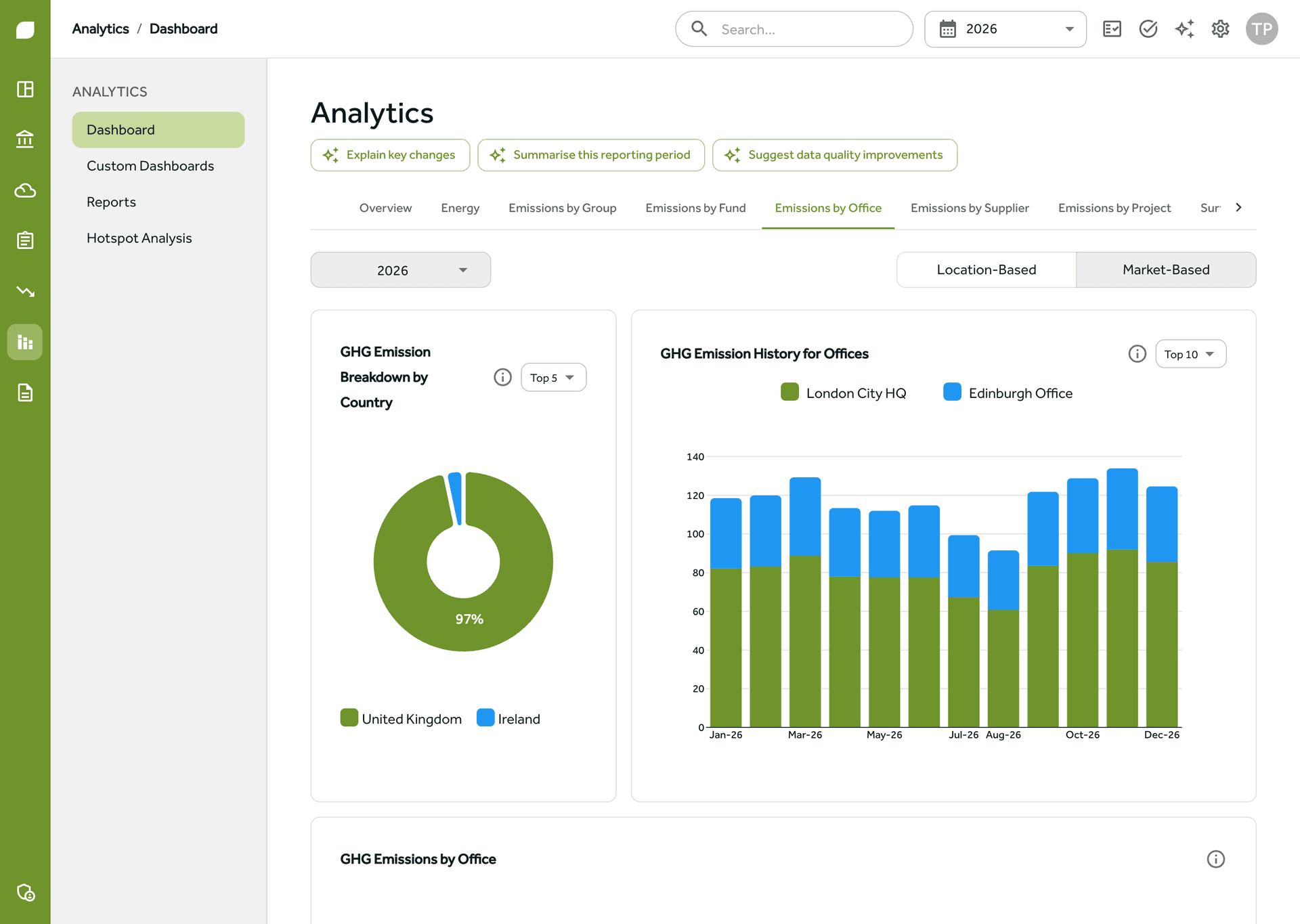
Where a financial services firm's emissions sit
As an organisation, your footprint looks nothing like a manufacturer's. Scope 1 is small, because you own little that burns fuel. Scope 2 is the electricity behind your offices and branches. The bulk sits in Scope 3, in the goods and services you buy: professional fees, technology, marketing, facilities, plus the business travel that goes with client work. That kind of footprint is measured mostly from spend and supplier data rather than meter readings, so it needs carbon accounting software that treats spend data with the same discipline as an energy bill.
The scrutiny is higher in your sector than most. Large firms and LLPs report under Streamlined Energy and Carbon Reporting (SECR), the UK Sustainability Reporting Standards (UK SRS) are on the way, and clients and procurement teams increasingly ask for numbers before they sign. A regulated firm's figures get read closely, so how each number was produced matters as much as the number itself. Gaia keeps one dataset behind all of it.
Measure the footprint that arrives on invoices
Most of a professional-services footprint is bought, not burned. Connect Xero, QuickBooks or Sage, or import spend files with per-row validation, and map each nominal code once: chart of accounts mapping categorises every future import automatically, and wages, VAT and depreciation can be excluded so they never inflate the footprint. Supplier intelligence matches supplier names against Companies House data and picks the right DEFRA spend factor, flagging uncertain matches for review rather than guessing. CPI inflation adjustment keeps multi-year spend comparable, following GHG Protocol Scope 3 guidance, with every adjustment reasoned and auditable.
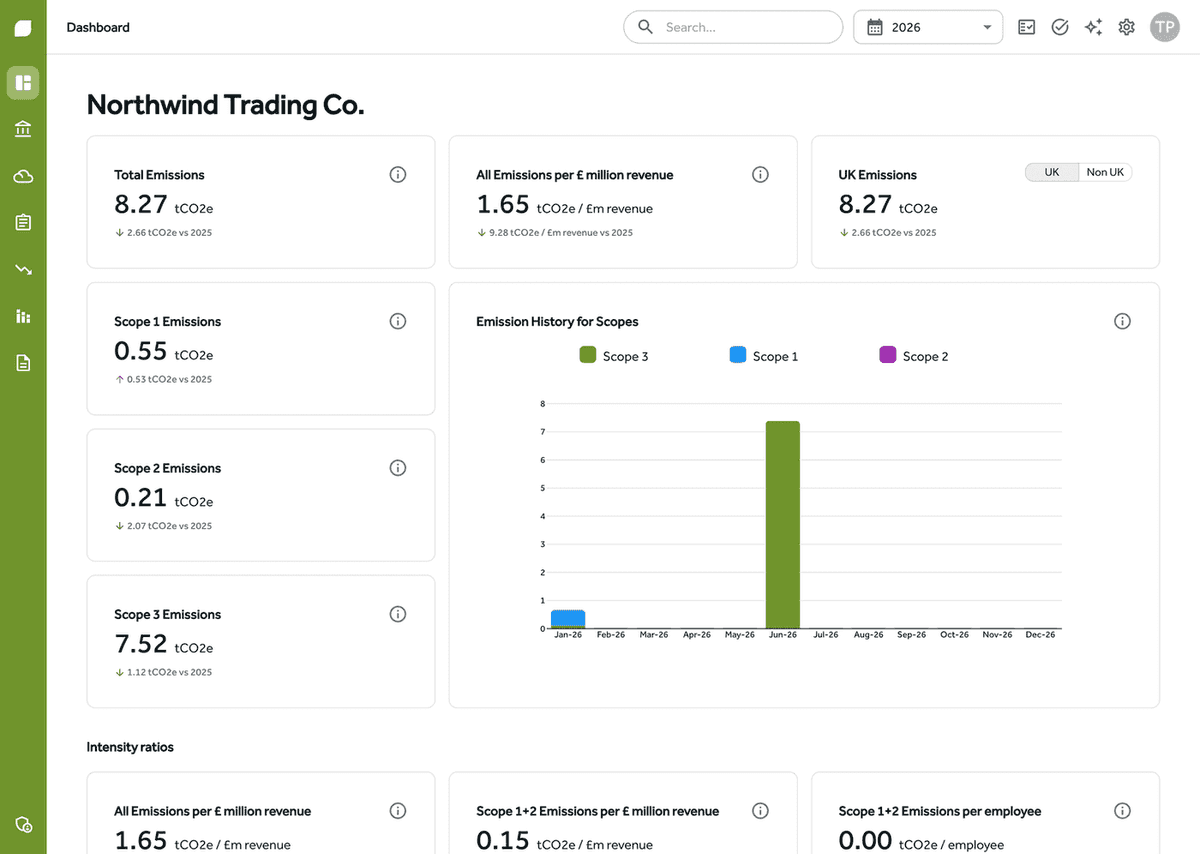
Every site and every trip in one view
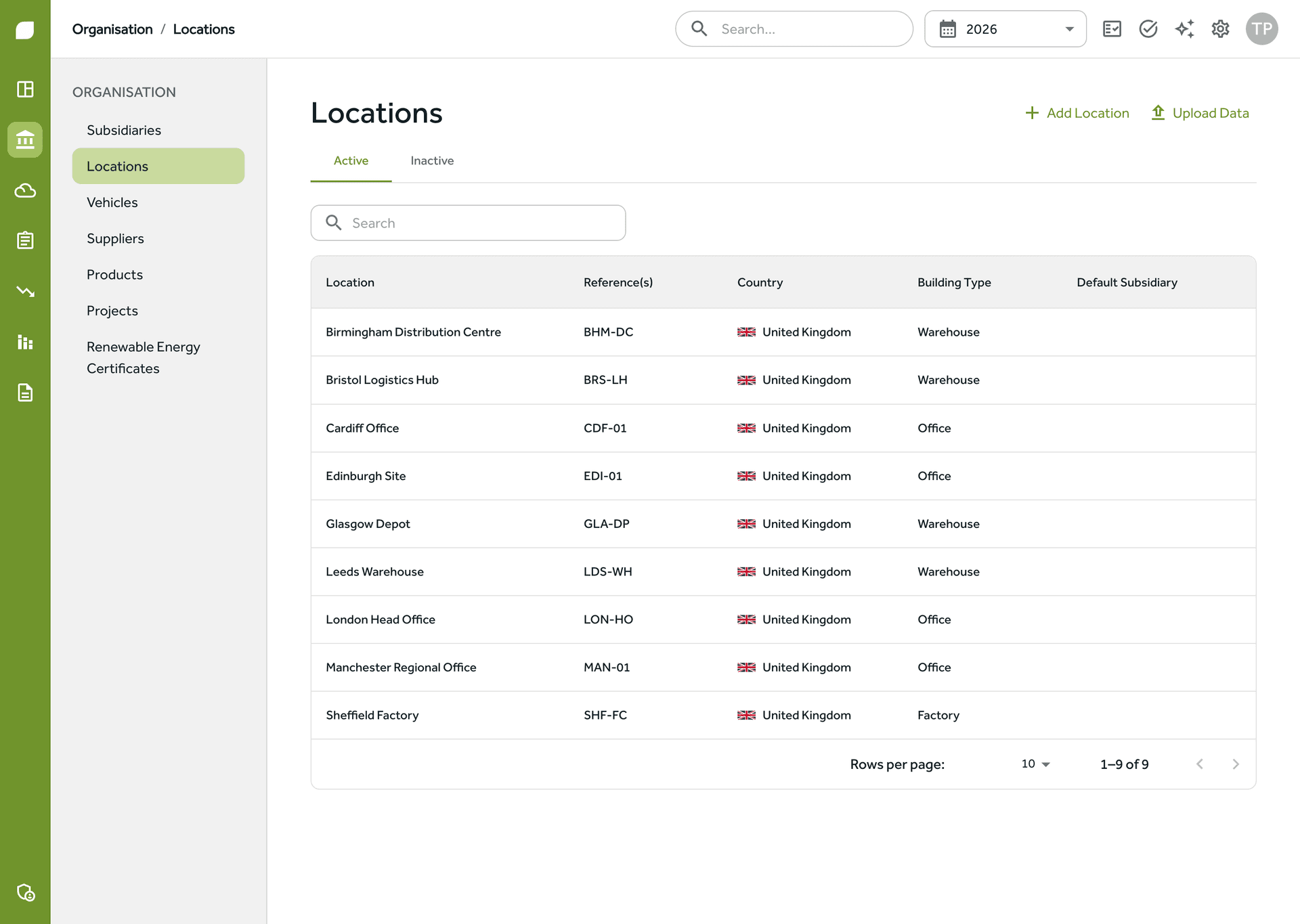
Gaia tracks Scope 1 and 2 across every office and branch in one view, using the UK Government conversion factors from DEFRA and DESNZ. Upload a PDF or photo of an electricity or gas bill and the platform reads the consumption; a person confirms it before anything counts, and the bill stays attached as audit evidence. For a serviced office or branch with no bills of its own, floor-area estimation produces a figure that is always flagged as estimated and superseded the moment metered data arrives. Business travel, from flights and rail to mileage, is captured under Scope 3 alongside it.
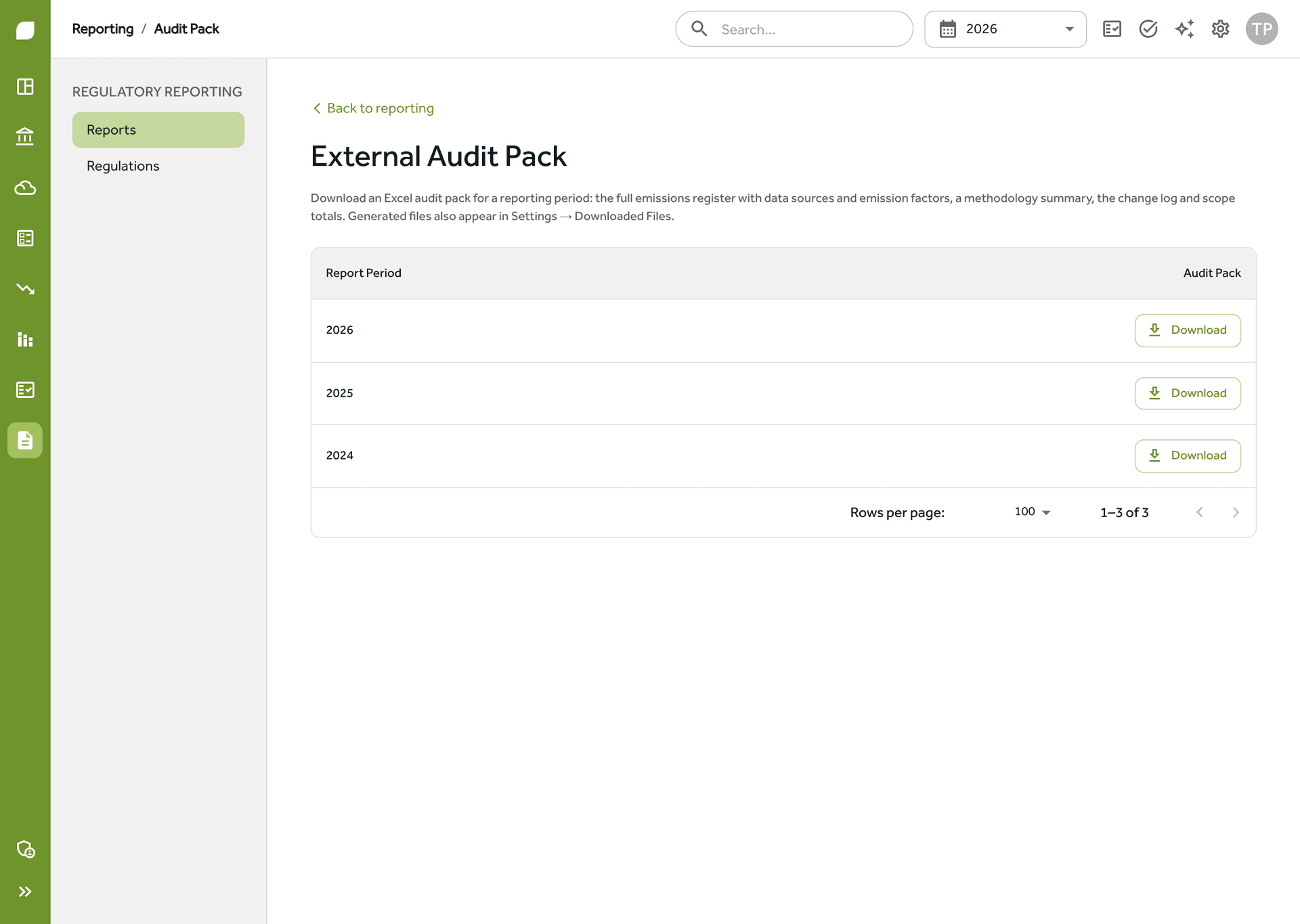
Figures a regulated firm can defend
Every emission carries its evidence: the bill, invoice or certificate sits attached to the figure it supports. A field-level audit trail records who changed what, and when. The external audit pack exports a workbook with every calculation, its factor, its data-quality tier, the evidence list and the assumptions register, ready for whoever checks your numbers. The data-quality mix shows the composition of methods behind each report, from supplier-specific to spend-based, and is never dressed up as an accuracy percentage. SECR, UK SRS and GHG Protocol reports all draw on the same dataset, so the numbers reconcile wherever they appear.
What Gaia measures for financial services firms
One dataset for the emissions behind your own operations, from the branch network to the technology stack.
Offices and branches
Business travel
Purchased services
Technology procurement
Offer carbon accounting to your own business clients
Your business customers face the same reporting pressure you do, and many of them will look to their bank or adviser first. Through Gaia's partner programme, a financial institution can offer carbon accounting to its own clients under its own brand. White-labelling covers your logo, colours and domain, and the reports and emails your clients receive. A client book shows every client's footprint, data quality and report status on one page, your team can step into a client's account directly with every access audit-logged, and a REST API with organisation-scoped keys connects the platform to your own systems.
Carbon accounting for financial services, answered
Does SECR apply to our firm?
SECR applies to UK quoted companies and to large unquoted companies and LLPs, meaning those that meet two of three criteria: 250 employees, £36m in turnover, or £18m in assets. Many banks, insurers, asset managers and advisory LLPs qualify. Gaia assesses whether SECR or ESOS applies to your organisation for a reporting period, with a reason given against each criterion, and says "insufficient data" rather than guessing. The SECR reporting page covers the duties in detail.
How can purchased services be measured from spend?
Each line of spend is converted to emissions using the UK Government's DEFRA spend factors, with chart of accounts mapping and supplier matching choosing the right factor per line. Because spend factors reflect prices from the year they were built, Gaia applies CPI inflation adjustment in line with GHG Protocol Scope 3 guidance, per currency, with every adjustment reasoned and auditable. The data-quality mix then shows exactly how much of a report rests on spend-based figures versus supplier-specific data, so the method is never hidden.
How do we evidence our figures for auditors, regulators or procurement?
Three layers. Evidence files (bills, invoices, certificates) attach to the individual emissions they support. A field-level audit trail records every change with who made it and when. And the external audit pack exports the whole working as a workbook: every calculation, its factor, its data-quality tier, the evidence list, the assumptions register and the factor-year change history. When new conversion factors publish, nothing is restated silently: Gaia shows you what would change and recalculates only on your say-so, and locked periods are never rewritten.
Can we offer the platform to our own business customers?
Yes. The partner programme lets a bank, insurer or advisory firm offer carbon accounting to its own clients with full white-labelling, so the product carries your brand end to end, including reports and emails. You get a client book showing every client's footprint and report status, audit-logged access to client accounts, and API access for your own integrations.
Which frameworks can we report against?
SECR, the GHG Protocol Corporate Standard and UK SRS, all from the same dataset. The UK SRS report follows the four-pillar IFRS S2 shape (governance, strategy, risk management, metrics and targets); the UK government confirmed implementation on 25 February 2026, and the standards are expected to take effect from 2027. Gaia also produces CSRD/ESRS E1 climate disclosures for UK firms with EU exposure, B Corp environmental figures, and the PPN 006 Carbon Reduction Plan needed for public-sector bids.
Trusted carbon data



Aligned with the standards your reports rely on
Gaia is aligned with the Greenhouse Gas Protocol (GHG Protocol) methodology and uses recognised industry-standard data to calculate your emissions, including the annual UK conversion factors published by the Department for Environment, Food and Rural Affairs (DEFRA) and the Department for Energy Security and Net Zero (DESNZ).
See it in sixty seconds
Nine real product screens in the order you would meet them. Press play, or step through at your own pace.
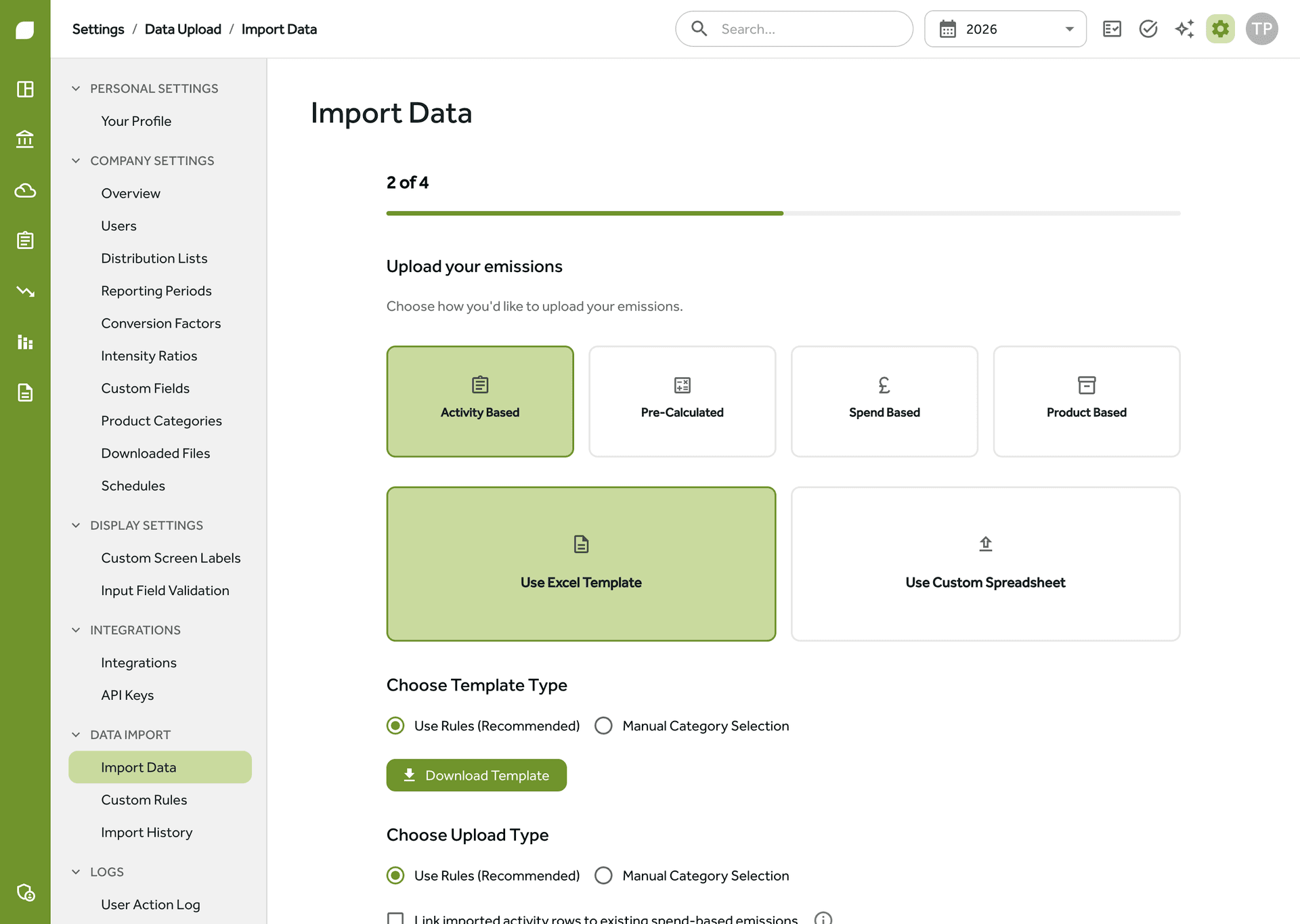
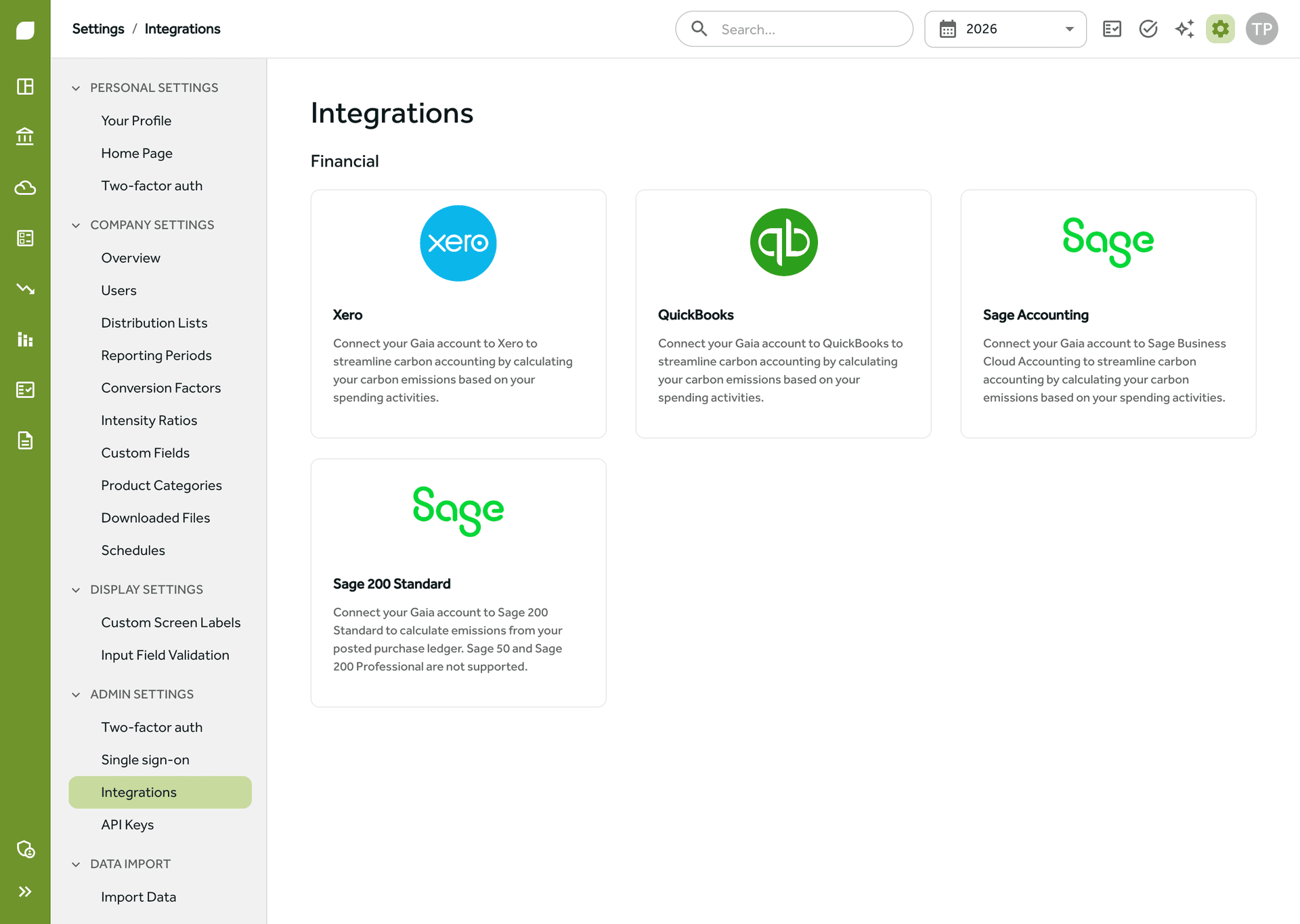
Every route in validates before anything counts
Spreadsheets, accounting integrations, bill extraction or the API: the import wizard checks every row and says exactly what failed and why, so you fix the file instead of hunting through it. See the full walkthrough
Put defensible numbers behind your next disclosure
See how Gaia measures your firm's footprint and produces the reports behind it, with pricing from £300 + VAT per month.