
Key Takeaways:
- Green building practices are redefining the built environment through energy efficiency, eco-friendly design, and reduced greenhouse gas emissions.
- Sustainable materials like CLT, low-carbon concrete, and recycled steel are becoming mainstream as the UK strengthens its carbon policies.
- Energy-efficient design, renewable integration, and passive solar strategies help buildings generate clean energy and minimise dependence on fossil fuels.
- Water conservation, waste reduction, and circular construction methods are moving the industry towards long-term sustainability.
- Smart building systems and automation are transforming how energy, lighting, and ventilation are managed, making buildings both efficient and responsive.
- Early green considerations in the design and construction process can prevent future hassle, funds, and energy loss, helping projects meet sustainability goals from the start.
Green building practices are redefining the built environment through energy efficiency, eco-friendly design, and reduced greenhouse gas emissions.
As we move towards net zero carbon goals, sustainable building solutions are cutting energy consumption and dependence on fossil fuels.
With renewable energy sources, innovative construction methods, and smarter construction techniques, developers can enhance indoor air quality, maximise natural light, and support human health.
By using friendly materials and lowering the environmental footprint, the industry is creating spaces that benefit both people and the planet.
This article explores ten key practices driving the Green Building Council’s vision for a sustainable, net zero future.
What are Green Building Practices?
Green building practices involve considering nature at the very start of the development process, before any plans have been made.
This allows the designs and methods to be shaped in a way that reduces the building’s environmental impact as much as it can.
As of February 2024, green building practices are a national requirement for the majority of all new developments in England.
Policy Biodiversity Net Gain enforces that new developments must contribute at least a 10% net gain towards England’s biodiversity levels. Following the mitigation hierarchy, this must first be attempted on-site – with green considerations to avoid habitat loss at all costs.
Beyond BNG, carbon accounting is slowly becoming mandatory for more and more companies. Because of this, it’s smart to think ahead and consider green building practises with any new developments.
For instance, using sustainable materials, low-carbon designs, and energy-efficient systems can save thousands of pounds and months of effort when it comes to Carbon Accounting (CA).
Carbon Accounting involves measuring the exact amount of emissions your business is producing across all operations, to then identify the key carbon hotspots to tackle.
If green building practices were implemented first thing, much future hassle, funds and energy would have been prevented.
What are the Benefits of Green Building Practices?
Implementing green practices into business is beneficial regardless of industry, as it future-proofs companies against inevitable environmental policies and regulations.
With green building practices, many of the benefits revolve around appealing to the right people:
- Cost-conscious customers, who are drawn to energy-efficient homes with lower monthly bills
- Local Planning Authorities (LPAs), who are more likely to approve sustainable developments
- Investors, who value long-term stability and higher resale potential
- Environmentally conscious customers, who prioritise sustainability
- Customers who value health and comfort, attracted by better air quality and natural living conditions
- Regulators and policymakers, who find compliant developments easier to approve and more aligned with future environmental goals
- Corporate stakeholders, who benefit from partnering with a forward-thinking, sustainability-led business.
It’s not just beneficial to do so, but consequential to not do so. Financially, you’ll face rising operational costs and reduced property value. You’ll miss eligibility for government incentives.
Regulatory defiance can equate to hefty fines, risking planning rejections or costly future retrofits.
Moreover, reputationally, you could be perceived as outdated or environmentally irresponsible.
This is why it’s crucial to drive a successful business by putting the planet first.
1. Use of Sustainable Materials
Sustainable materials are becoming increasingly mainstream and accessible as the UK’s carbon policies strengthen and fall into place.
As of today, the UK has a few main frontrunners:
- CLT (Cross-Laminated Timber) replaces carbon-intensive concrete or steel, both storing carbon itself and very low carbon emissions. Its higher upfront cost saves on labour and time, however can’t be used yet for tall buildings due its flammability.
- LCC (Low-Carbon Concrete) replaces standard concrete, halving carbon emissions up to half with fly ash or GBBS. It’s similarly priced to normal concrete – but normal concrete stays in business because of trust, ease of use, and familiarity.
- Recycled steel is widely used in modern construction for beams, frames, and reinforcements. Produced mainly through electric arc furnaces, it significantly reduces emissions compared with virgin steel production and is supported by an established national recycling network.
2. Energy-Efficient Design
With advancing technology comes new opportunities for energy efficient design.
While there are countless new designs arising, the UK’s most prominent are:
- High-performance insulation & glazing used for walls, roofs, and windows. It maintains indoor temperature and prevents heat loss. With moderate costs, these are now standard in most new builds.
- Heat pumps are heating and cooling systems cutting up to 70% of emissions by transferring heat with electricity instead of fuel, with high upfront but growingly accessible.
- Smart energy management systems that adjust a building’s energy usage automatically based on where it’s needed and not needed – cutting masses of ambient spending.
3. Green Roofs and Walls
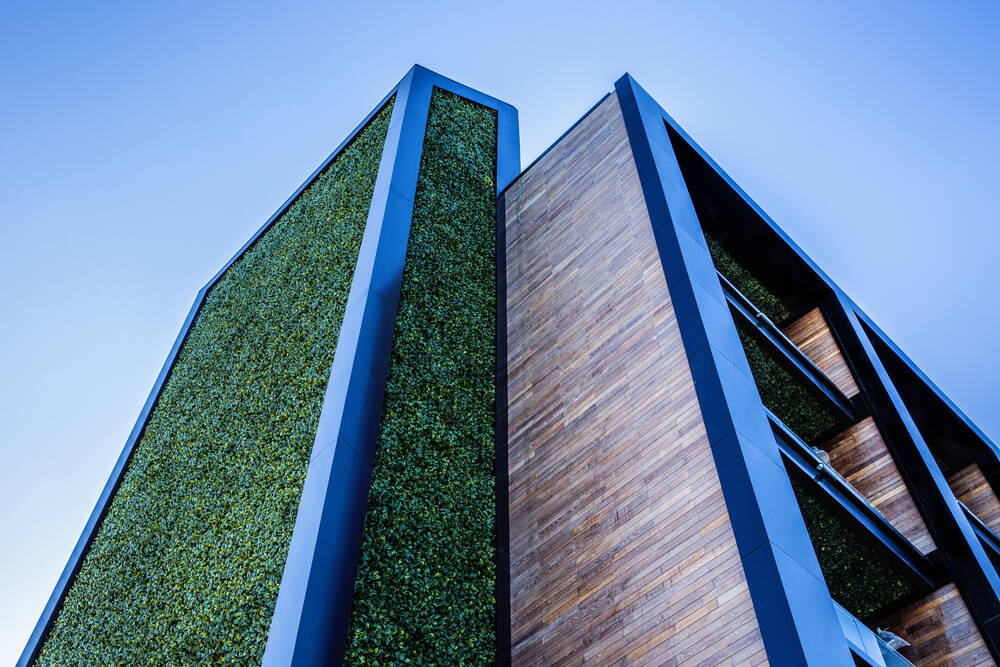
Green roofs and walls are less common in the UK, however development in England under the new Biodiversity Net Gain law calls for on-site habitat recreation where possible, which means that creative environmental considerations such as green roofs will be integrated into architectural planning.
Notable examples include the Barbican green roof built in the early 1980s and the Crossrail Place Roof Garden created in 2015, both bringing greenery, biodiversity, and public access to densely developed urban areas.
They can offer rare refuge for nature in cities, with native plant species supporting pollinators and local wildlife such as birds. They mitigate rainwater runoff, with the roofs instead absorbing and retaining the rain, reducing risks of stormwater erosion and flooding.
4. Water Conservation Systems
Water conservation systems were first introduced in the 70s to combat water scarcity from rising urban demand. These first models started as basic rain barrels or tanks for rainwater harvesting, used mostly in rural areas for outdoor activities.
Today, most sustainable UK developers use some form of water conservation, though usually simpler features like low-flow taps, showers, or dual-flush toilets.
Technology has since advanced to fully integrated systems with UV filters, automated controls, pumps, and smart meters.
They’re more expensive and complex but are becoming increasingly accessible as costs fall and water efficiency becomes a stronger planning requirement – e.g. the UK’s 2025 update to Building Regulations Part G.
5. Passive Solar Design
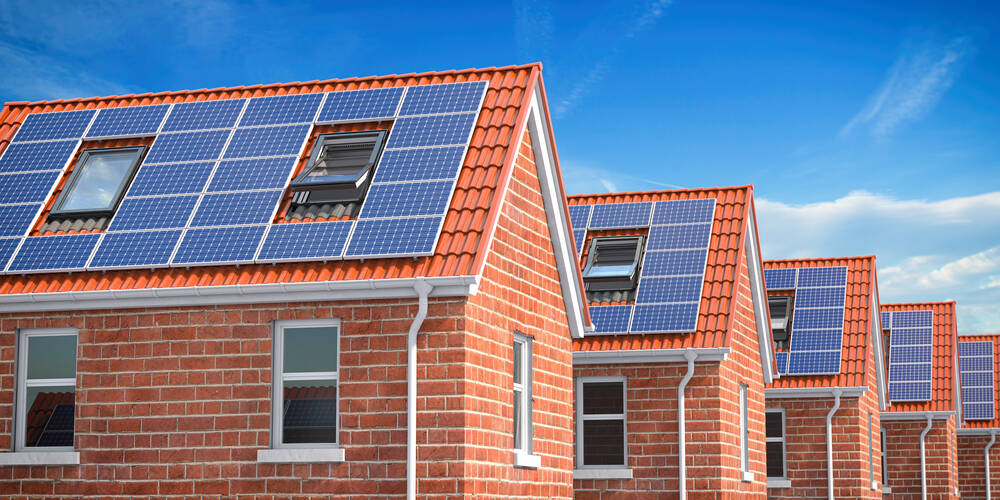
Passive solar design involves building houses that harness the most significant heat source there is – the sun.
Houses are positioned with windows capturing sunlight in winter, but not in summer. Buildings are made with materials like concrete and stone, storing thermal energy which gets released slowly at night.
This practice is as environmental as they come, highlighting that considerations at the very start of the project can save so much time and effort in the long run.
Think south-facing windows, brick, stone, and shading from roofs or eaves to block extra heat.
6. High-Performance Windows and Insulation
High-performance windows simply mean that they’re multiple glazed (two / three panes of glass instead of just one) and might have low emissivity coatings (reflect heat strategically).
It means your windows work smarter and harder, cutting heat loss hugely. Green building logic combines this efficiency with insulation in floors, roofs and walls to stop thermal leaks.
These are now standard in most UK new builds as the effects go a long way. Retrofits of older buildings are helping them catch up in order to meet EPC targets and reduce costs of bills.
7. Efficient Heating, Ventilation, and Cooling Systems
HVAC (Heating, Ventilation, and Cooling) systems encompass a range of smart tech including heat pumps, MVHR, smart thermostats and more.
Their sole aim is to use less energy while keeping spaces comfortable, with heat pumps pulling hot or cold air in from outside, MVHR bringing in fresh air, or smart sensors automatically adjusting temperatures.
With grants like the Boiler Upgrade Scheme (BUS) offering £7,500 off heat pumps for homeowners 2022 – 2027, the systems are becoming more accessible.
As energy standards tighten, efficient HVAC systems are shifting from premium features to standard practice.
8. Renewable Energy Integration
We are in the midst of the renewable energy transition – the UK’s very last coal-fired power plant was shut down back in 2024, our wind power is rising rapidly and our solar power is expanding fast.
Rather than just adding solar panels at the end, green building practices consider integration from the very start.
This might look like roofs angled for maximum solar exposure, on-site renewable heat (heat pumps, biomass boilers), and electrical systems linked to battery and renewable sources.
When buildings are able to generate their own clean energy with efficient systems built into the heart of the design, they become key tools in the fight against climate change.
9. Waste Reduction and Recycling During Construction
With around 61% of total UK waste coming from construction in 2021, it’s one of the UK’s most significant waste producers.
This includes concrete, plastic, soil, wood, metal and more – with around 94% of it recovered (i.e. recycled, used as fill, burned for energy, or crushed) but only around 9% truly reused.
While recovery does keep waste out of landfill, recovery uses lots of energy and reduces material quality.
Green building practices tackle the problem at the source – such as by:
- Designing efficiently, to use as little materials as possible
- Using prefabricated or modular components (assembled like large lego pieces, with much less waste or emissions)
- Adaptive reuse of buildings (repurposing instead of demolishing)
- Digital modelling, optimising designs to prevent errors and rework (spot clashes early, use shared models, calculate precisely).
With early on green considerations, we move construction towards the circular economy it needs to be.
10. Smart Building Technologies and Automation
Smart building systems monitor data from sensors and adjust heating, cooling, ventilation, and lighting automatically to cut waste and stay efficient:
- Heating turns on when indoor temperatures drop, and off when heat builds up naturally.
- Ventilation turns on when pollutants or CO₂ are detected, and off when air quality improves.
- Lights turn on when someone enters a dark space, and off when no one is there.
These adjustments happen automatically in real time, keeping comfort steady while using as little energy as possible.
That’s just one example of green building practices supporting sustainable construction by embracing new technologies, slashing carbon emissions, optimising product lifespans and supporting a circular economy.
More Information
https://www.gov.uk/government/statistics/uk-waste-data/uk-statistics-on-waste
https://www.gov.uk/government/publications/net-zero-strategy
https://energysavingtrust.org.uk/business/renewable-energy
https://www.neso.energy/publications/future-energy-scenarios-fes
https://www.bsigroup.com/en-GB/industries/built-environment/digital-trust-in-the-built-environment
https://www.cibse.org/knowledge-research
FAQs
What are green building practices?
Green building practices involve considering nature at the very start of the development process, before any plans have been made. This allows the designs and methods to be shaped in a way that reduces the building’s environmental impact as much as it can.
Why are green building practices important today?
As we move towards net zero carbon goals, sustainable building solutions are cutting energy consumption and dependence on fossil fuels.
How do green buildings benefit businesses and developers?
Implementing green practices into business is beneficial regardless of industry, as it future-proofs companies against inevitable environmental policies and regulations.
How do green roofs and walls contribute to sustainability?
They bring greenery, biodiversity, and public access to urban areas, while absorbing rainwater, reducing runoff, and supporting local wildlife such as birds and pollinators.
When should green building practices be considered in development?
Green building practices should be implemented at the very start of the development process, before any plans have been made, to reduce environmental impact as much as possible.